The Rise of Task-Oriented Chatbots: Automating Complex Customer Requests
Chatbots Evolution: From Responders to Doers
Oct 8, 2025
5 mins
Explore how AI-driven chatbots are becoming task-oriented assistants capable of managing complex customer requests, from tracking orders to completing returns.
The Rise of Task-Oriented Chatbots: Automating Complex Customer Requests
The early generations of chatbots were limited to answering simple questions. They worked well for repetitive FAQs like “What are your delivery times?” or “How do I reset my password?”
But customers today expect more. They want a chatbot that can do things, not just talk.
This growing demand for action is driving a major shift in AI design: the rise of task-oriented chatbots.
According to Gartner, by 2026, more than 40% of customer interactions will be handled from start to finish by AI without human intervention. The reason is simple, AI is no longer just conversational. It’s becoming operational.
Task-oriented chatbots are built not to reply, but to resolve.
1. What Makes a Chatbot “Task-Oriented”
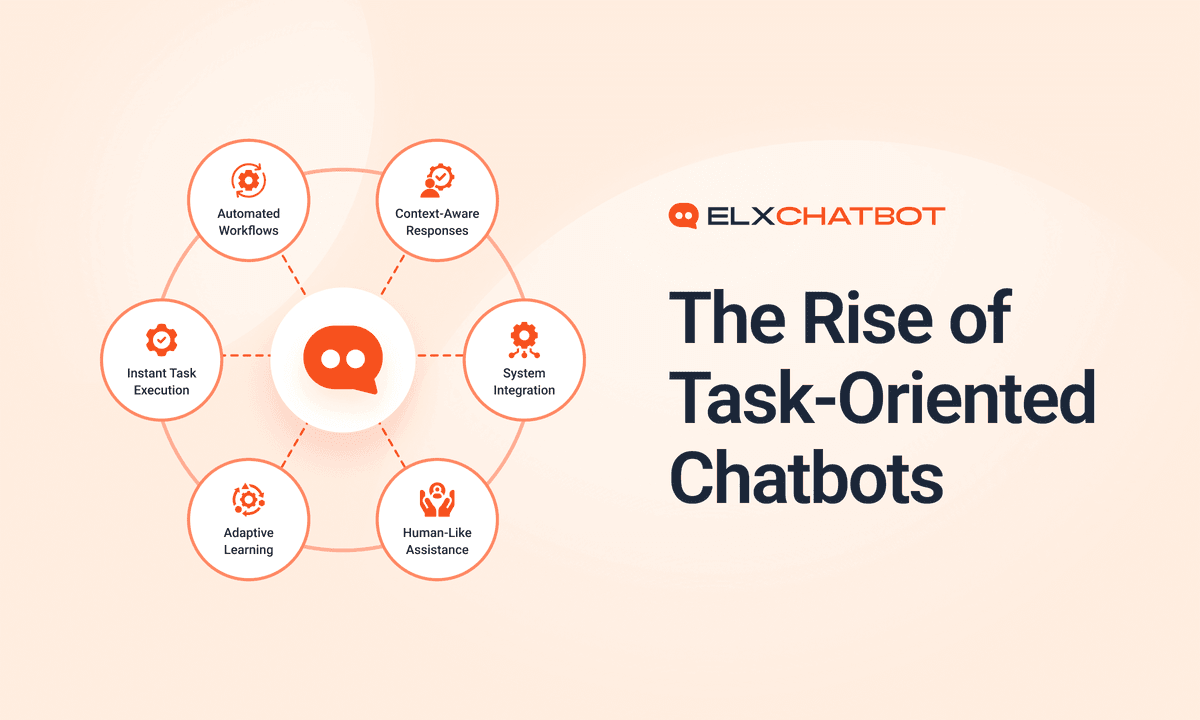
A traditional chatbot answers questions using pre-set replies or content pulled from an FAQ. A task-oriented chatbot, however, goes several steps further. It can understand context, access systems, and perform multi-step actions on behalf of the customer.
For example, a task-oriented chatbot can:
- Retrieve real-time order status.
- Modify delivery information.
- Initiate a return or replacement.
- Apply loyalty points or discounts.
- Check product availability and place orders.
It acts like a digital service agent capable of interpreting intent, pulling data, and executing actions that previously required human staff.
ELX Chatbot has been designed with this progression in mind. Its architecture supports integrations with major eCommerce systems like Shopify, Magento, WooCommerce, and BigCommerce, allowing it to handle real customer requests instantly.
2. Why This Evolution Matters
Customer expectations have never been higher. Shoppers want instant solutions, not links or redirects. When a chatbot can resolve their issue directly, satisfaction increases dramatically.
A study by Salesforce found that 69% of customers prefer using chatbots for quick problem resolution, but only when the chatbot can actually get things done.
That difference between answering and resolving, is where the real value lies.
Task-oriented bots don’t deflect, they deliver outcomes. They transform customer experiences from passive interactions into active service moments.
3.How Task-Oriented Chatbots Work
A task-oriented chatbot combines three layers of intelligence to deliver complete solutions:
Natural Language Understanding (NLU): The chatbot interprets user intent accurately, even from complex or vague phrasing.
System Integration: It connects with backend systems, eCommerce platforms, CRMs, order databases, and APIs to fetch or update information.
Workflow Automation: It executes multi-step processes like order cancellations, returns, or modifications automatically.
Together, these layers enable a chatbot to operate as an end-to-end service channel.
When a customer says, “I’d like to exchange my shoes for a different size,” a task-oriented chatbot doesn’t just explain how to do it, it processes the exchange directly and sends confirmation.
4. Real-World Examples of Task Automation in Action
The impact of this technology is already visible across industries:
Retail and eCommerce: Chatbots handle order tracking, returns, and personalized product recommendations.
Travel: Bots reschedule flights, update seat preferences, and issue digital boarding passes.
Telecom: Customers can upgrade plans or pay bills instantly through chat.
Banking: AI agents help users check balances, transfer funds, and dispute charges securely.
For eCommerce in particular, task-oriented chatbots are redefining customer service. With ELX Chatbot, customers can check order details, request returns, and receive live tracking updates, all in one conversation.
The result is faster resolution, fewer human interventions, and higher satisfaction.
5. The Business Value of Automating Complex Tasks
The benefits of implementing task-oriented automation extend beyond convenience. Businesses see measurable gains in efficiency, cost savings, and customer retention.
Key benefits include:
Reduced support workload: Routine queries are handled instantly by AI, freeing agents for high-value tasks.
Increased customer satisfaction: Faster, self-service solutions create stronger brand loyalty.
Higher conversion rates: Chatbots can guide users through purchasing or checkout flows seamlessly.
24/7 operational coverage: Complex customer needs are met anytime, anywhere.
According to IBM, businesses using AI-powered automation have seen support costs drop by up to 30%, while maintaining or improving customer satisfaction.
That balance, efficiency without compromise, is exactly what task-oriented chatbots achieve.
6. What Makes ELX Chatbot Ready for Task-Oriented Automation
ELX Chatbot already supports many of the foundational capabilities required for true task orientation:
**Real-time eCommerce integration: **Automatically retrieves and updates order data from connected stores.
**Workflow execution: **Handles customer actions such as order status requests, returns, and cancellations.
**Custom data feeds: **Connects with bespoke systems and APIs for advanced use cases.
**Adaptive learning: **Continuously improves understanding through repeated interactions.
This flexibility allows ELX Chatbot to grow with each business, starting with FAQs and evolving toward full, autonomous service operations.
7.The Future of Customer Interaction: AI That Acts
The most exciting phase of chatbot evolution is happening now. Chatbots are no longer limited to text replies; they’re becoming AI agents capable of taking meaningful action.
As integrations deepen and language models become more capable, task-oriented chatbots will soon be able to:
- Combine multiple data sources to give more complete answers.
- Detect emotional tone and adjust responses accordingly.
- Predict what customers need next, offering proactive solutions.
This means the customer’s first point of contact will not just understand their problem, it will solve it, instantly.
ELX Chatbot is designed for exactly this kind of growth. As AI systems mature, it can adapt into a true service agent, handling end-to-end customer interactions with speed, accuracy, and empathy.
Final Thoughts: From Conversations to Completion
The next generation of AI is defined by completion, not conversation. Customers no longer want to chat, they want things done.
Task-oriented chatbots represent a major leap forward, combining the best of automation, intelligence, and user experience. They are faster than human agents, available around the clock, and capable of solving real problems instantly.
As businesses embrace this new wave of automation, ELX Chatbot is positioned at the forefront, bridging the gap between conversation and action, and helping brands deliver service that feels as intelligent as it is effortless.
Start Free Trial or Book a Demo to see ELX Chatbot in action today!




More Blogs
Explore more insights, tips, and stories from our team.